Marriage card game terms
These terms explain the card roles, melds and scoring switches used in the rule pages. Points that disagree are written out; they are not averaged. Source counts describe the row’s references; field-specific gaps and disagreements are stated in the cells or linked guide.
| Name | Definition | Wild | Maal | Example | Status |
|---|---|---|---|---|---|
| Tiplu तिप्लु | The card drawn blind from the stock the first time a player completes the show; it fixes the wild rank and the maal for the rest of the deal. | yes | 3 single; 7 double (Pagat); 8 double (Wikipedia); three tiplu cannot form a tunnela | If the tiplu is 7♥, all three 7♥ in the three packs are tiplu; the 8♥ is poplu and the 6♥ is jhiplu. | 3 sources |
| Poplu पोप्लु | The card one rank above the tiplu in the tiplu's suit; wild and worth maal. | yes | 2 single; 5 double; 10 triple; 20 as a tunnela (Pagat); 15 as a tunnela (Wikipedia) | Tiplu 7♥ makes the three 8♥ poplu. | 2 sources |
| Jhiplu झिप्लु | The card one rank below the tiplu in the tiplu's suit; wild and worth maal. | yes | 2 single; 5 double; 10 triple; 20 as a tunnela (Pagat); 15 as a tunnela (Wikipedia) | Tiplu 7♥ makes the three 6♥ jhiplu. | 2 sources |
| Alter अल्टर | The tiplu's rank in the other suit of the same colour; optional wild worth maal. | yes when the alter rule is on | 5 single; 15 double; 25 triple (Wikipedia, Nepali Games, MySansar); a 4th alter is 30 in the Niyamawali | Tiplu 7♥ makes the three 7♦ alter. | 3 sources |
| Putali पुतली | A printed joker, one per pack, wild from the deal and worth maal without waiting for a tiplu. | yes | 5 single; 15 double; 25 triple; 30 four (Niyamawali); three putali as a tunnela 45 | Three printed jokers held together are three putali; two score 15, one scores 5. | 3 sources |
| Master card मास्टर कार्ड | One extra printed wild card added to the 160-card shoe; the highest single maal card. | yes | 10 when held or used as a dublee partner; 5 when substituted into a pure sequence | A master card can fill 5♠-6♠-7♠ as the 6♠, but drops to 5 points while doing so. | 2 sources |
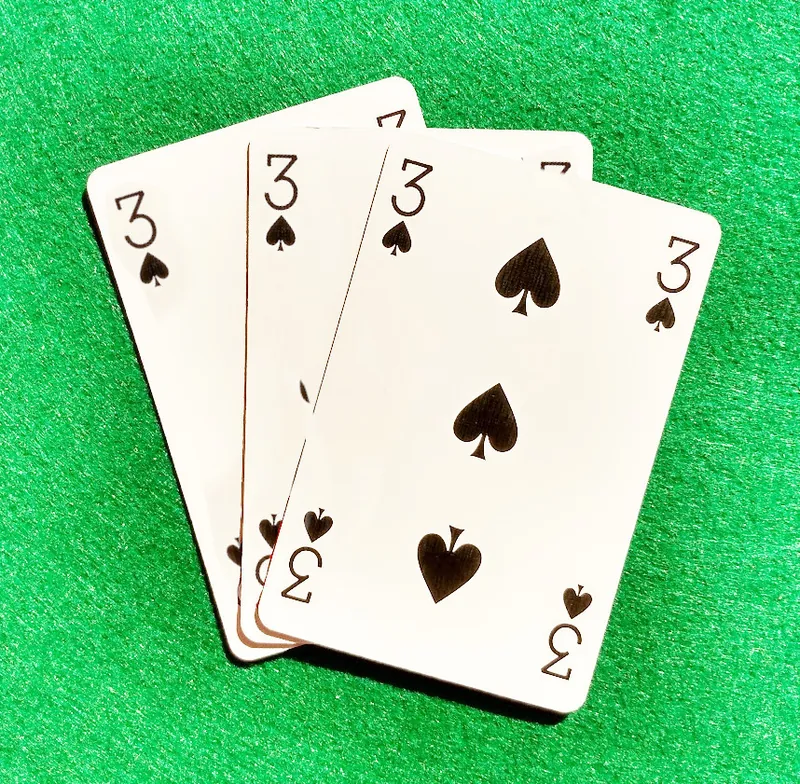
| Tunnela टनेला | Three identical cards: same rank and same suit, one from each of the three packs. | no | 5 from the deal; 15 double; 25 triple; three putali 45; a tunnela pays only if the player goes on to see the tiplu | Three 7♦ are a tunnela; three 7s in different suits are a trial, not a tunnela. | 3 sources |
| Pure sequence शुद्ध सिक्वेन्स | Three or more consecutive cards of the same suit with no wild card. | no | 0 as a meld; its cards can still score as maal if they are tiplu/poplu/jhiplu | 5♠ 6♠ 7♠; A♥ 2♥ 3♥; Q♠ K♠ A♠. | 2 sources |
| Trial (set) ट्रायल | Three or four cards of the same rank in different suits. | no in the pure form; a joker may fill it in many house rules | 0 as a meld; no direct maal value | 9♠ 9♥ 9♦ is a trial; 9♠ 9♠ 9♠ is a tunnela. | 2 sources |
| Dublee डुप्ली | Two identical cards: same rank and same suit, from two different packs. | no; two jokers may count as a dublee in some rules | 0 base; +7 if the winner ends on a dublee (Wikipedia); +5 bonus for an eighth-dublee finish (Pagat, Niyamawali) | Two 8♣ form a dublee; seven dublees can show, eight can end the deal. | 3 sources |
| Marriage (tiplu + poplu + jhiplu) म्यारिज | A tiplu, a poplu and a jhiplu of the same suit held together; a bonus, not a separate meld. | no; the three cards are natural | 10 single; 30 double (Wikipedia, Nepali Games); 15 face-up and 35 double (Wikipedia table); 15 pre-maal / 10 at settle (Play Marriage) | With tiplu 7♥, holding 6♥ 7♥ 8♥ is a marriage. | 3 sources |
| Maal माल | The point cards of a deal and the points they carry: tiplu, poplu, jhiplu, alter, putali and master. | most maal cards are also wild | Sum of the maal cards held; values vary by card and by house rule | One tiplu (3) + one poplu (2) + one jhiplu (2) = 7 maal, or 10 as a marriage. | 3 sources |
| Murder मर्डर | A settlement rule that throws away the maal of every player who never showed. | no | 0 for unseen players; the rest of the settlement is unchanged | A player who never completed three sets loses all tiplu/poplu/jhiplu points under murder. | 3 sources |
| Kidnap किडन्याप | A settlement rule that gives the winner the maal of every player who never showed. | no | Winner receives the unseen players' maal instead of it being discarded | Under kidnap, an unseen player's tiplu points are paid to the winner. | 3 sources |
Use the points table when you only need the numbers, and the rules for the order of play. A round total belongs on the calculator.
Questions
What is a tiplu?
The card drawn blind from the stock by the first player who shows. It fixes the wild rank for that deal.
What is a tunnela?
Three cards of the same rank and the same suit, one from each deck. It is not the marriage trio.
What is murder versus kidnap?
Murder cancels the maal of a player who never showed. Kidnap gives that maal to the winner. They are switches, not the default on every table.
Sources
- Wikipedia — Marriage (card game) — checked 2026-11-16
- Pagat — Marriage — checked 2026-11-16
- Nepali Games — How to play Marriage — checked 2026-11-16
- Bhoos — Marriage FAQ — checked 2026-11-16